
Stony Brook researchers identify turkey-sized dinosaur that ate fruit
A new species called Infernogallus jamesi possessed jaw muscles similar to parrots, allowing it to mash soft food in the Hell Creek Formation.
By Hugo Cook ·
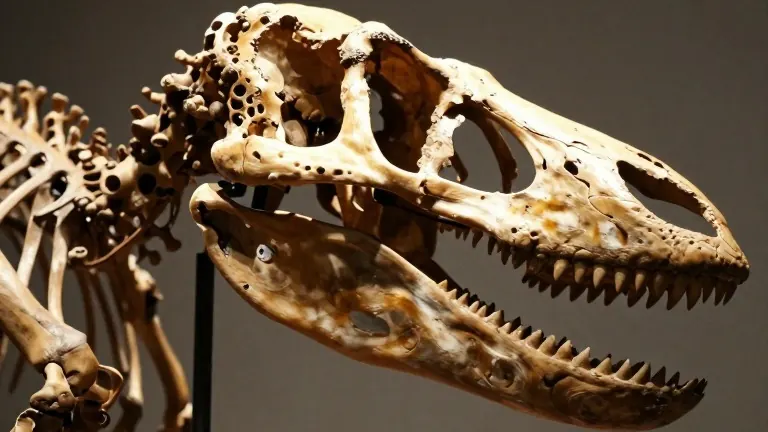
For more than a century, scientists assumed dinosaurs either chewed meat with rigid bites or swallowed plants whole. A new fossil discovery challenges that view by revealing a small dinosaur that developed specific muscle structures to process fruit. The finding suggests that these ancient reptiles evolved distinct dietary roles similar to modern birds.
An international team from Stony Brook University, the Royal Ontario Museum, and the North Dakota Geological Survey identified the new species, named Infernogallus jamesi. The animal belonged to the oviraptorosaur group, a family of bipedal, bird-like dinosaurs. It lived during the Cretaceous period, a timeframe spanning from 145 to 66 million years ago.
Greg Funston, an assistant professor in the Department of Anatomical Sciences at Stony Brook University’s Renaissance School of Medicine, led the research. The team analyzed the chewing mechanics of the creature and found a unique arrangement of muscles. This structure matches the anatomy seen only in fruit-eating parrots today. The detailed analysis is published in Nature Communications.
"We knew dinosaurs evolved to fill so many different roles in ecosystems in the Cretaceous, but we never expected to discover fruit-eating dinosaurs," Funston said. "For more than 100 years, we didn’t know what the skulls of these animals looked like. Now, we know they were even weirder than we could have predicted."
The fossils, including a nearly complete articulated skull and partial skeleton, were found in the Hell Creek Formation. This geological layer stretches across Montana, North Dakota, South Dakota, and Wyoming. The specimen is currently on display at the Royal Ontario Museum. During its lifetime, this turkey-sized animal shared its habitat with T. rex and Triceratops.
Infernogallus belonged to the caenagnathid group of toothless, feathered dinosaurs. It weighed approximately 12 kilograms, or 25 pounds, making it one of the smallest members of its group as an adult. The name Infernogallus, meaning "hell chicken," references the Hell Creek location where the remains were discovered.
The physical adaptations that enabled fruit consumption are located in the palatal bones, which form the roof of the mouth. Using CT scans, researchers reconstructed the skull and found that these bones arched downward into the oral cavity. This architecture caused specific muscles to face from front to back rather than up and down. This orientation allowed the beak to slide back and forth in a chewing motion, similar to human jaw movement, instead of the vertical biting seen in carnivores.
Thomas Dudgeon, a postdoctoral research fellow at the Royal Ontario Museum and co-author of the paper, noted that such specialization is rare. "It’s pretty rare for animals to become specialized for a diet of fruit, so when it happens, it comes with some remarkable adaptations," Dudgeon said. "The anatomy of Infernogallus is bizarre among dinosaurs, and we quickly realized that we were dealing with something special."
The discovery provides evidence that dinosaurs may have influenced the evolution of flowering plants. As seed-dispersers, these animals may have played a role similar to that of modern birds, reptiles, and small mammals. During the Cretaceous, flowering plants replaced cone-bearing plants as the dominant vegetation. The fossil record includes preserved fruits, indicating that such food sources were available for specialized consumers.
David Evans, Chief Curator of Natural History at the Royal Ontario Museum and senior author of the paper, emphasized the rarity of such finds. "Complete remains of small dinosaurs like Infernogallus are very rare in the fossil record. The strange skull of Infernogallus is an exciting find because it reveals surprising insights into dinosaur evolution and feeding specialization," Evans said. "This discovery shows that we still have a lot to learn about the world of T. rex, and about dinosaurs more generally."
Source: Stony Brook University News