Lunar Cargo: Griffin-1 Lander Completes JPL Vibration and Thermal Trials
The spacecraft survived simulated launch stresses at NASA's Jet Propulsion Laboratory, clearing a final hurdle for its late 2026 launch.
By Hugo Cook ·
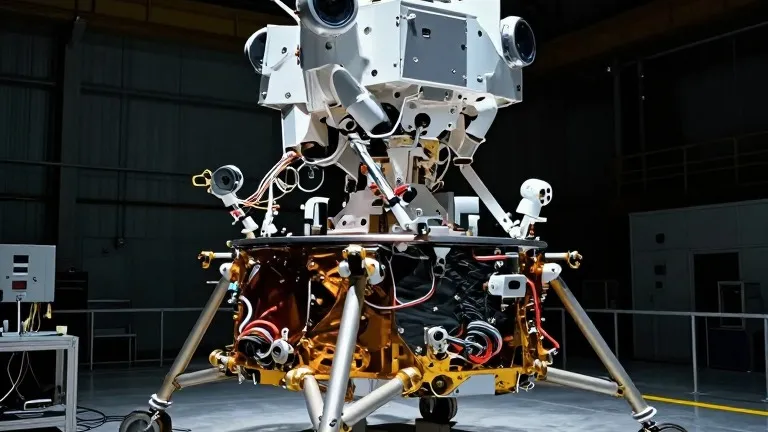
Voyager Technologies has confirmed that its Griffin-1 lander has successfully completed a series of rigorous environmental tests at NASA's Jet Propulsion Laboratory (JPL) in Southern California. The trials concluded on October 23, positioning the robotic spacecraft for a launch later this year under the agency's Commercial Lunar Payload Services initiative.
The testing regimen was engineered to replicate the physical stresses of a lunar transit. Engineers subjected the lander to extreme temperature fluctuations, high-intensity vibration, and acoustic environments that mirror the noise levels of a rocket ascent. JPL released an image on August 31 showing the vehicle inside the facility's 25-foot-wide space simulator during these procedures.
The Griffin-1 mission is tasked with delivering a payload exceeding 1,100 pounds, or 455 kilograms, to a site near the lunar south pole. This cargo comprises various scientific instruments and new technologies intended for surface trials. A primary component is the FLIP rover, built by Astrolab, which will traverse the terrain while carrying a supercomputer designed to process data in the lunar environment.
Charles Whetsel, who manages the Exploration Systems Development Office at JPL, noted that the facility has supported robotic exploration since the Ranger program of the mid-1960s. Whetsel stated that the lab is proud to apply its expertise to support this new phase of commercial lunar exploration.
The Griffin-1 flight is one element in a longer-term plan to establish a permanent human presence on the moon. NASA aims to construct a crewed base near the south pole within the next five years, and data gathered from this commercial mission will inform the design and operations of that future facility.
Source: Space.com