Houthi Advance Strangles Taiz Water Supply, Pushing Residents Toward Crisis
A tightening siege on Yemen’s third-largest city has cut off critical supplies, forcing over one million people to stretch dwindling water reserves and endure rising costs.
By Madison Morris ·
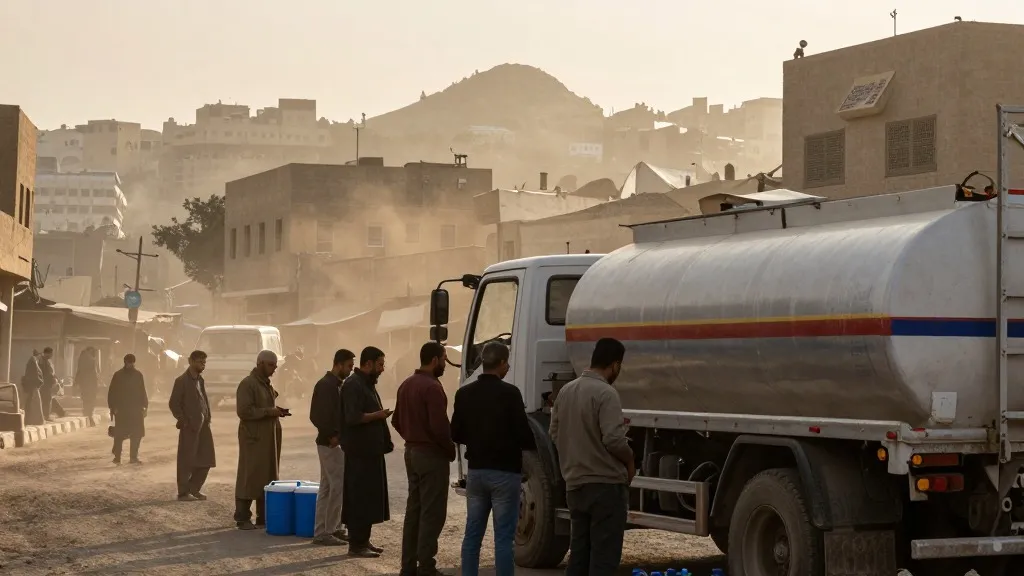
Water shortages in Taiz, Yemen, have escalated from a long-term struggle into an acute emergency this week. Humanitarian agencies report that the city’s supply lines are nearly broken, leaving more than one million residents with barely enough for daily survival. The situation has worsened as Iran-backed Houthi rebels continue to tighten their grip on the area, turning a decade-old infrastructure problem into an immediate threat to public health and stability.
The blockade has severed access to local wells and restricted fuel deliveries to desalination plants, forcing the city to rely on water trucks. These convoys are frequently blocked or face dangerous routes, causing prices for bottled water to jump by 75% in recent weeks. Some families are now purchasing water on credit, a shift that signals the depth of the financial strain. For Hadil al-Shahid, a local hair salon owner, the change is stark. She noted that she and her two children, who once used 10 liters of water daily, now stretch that amount over four days. Al-Shahid said, "We stopped drinking coffee and tea, which we used to drink daily." Her business has closed as customers prioritize basic necessities, and her children now subsist mostly on rice, bread, and cheese.
The crisis extends well beyond water. The siege has disrupted food distribution and fuel supplies, driving grocery prices up by roughly 50% since summer. Hospitals and sanitation services are struggling to function without adequate fuel, increasing the risk of disease outbreaks. Jens Laerke, a spokesperson for the UN emergency aid division, warned that the shortages feed into each other, making cholera and other illnesses more likely. He noted that many displaced families live in makeshift shelters and survive on a single meal a day. Hani Bafaqih of the aid group CARE added that cooking gas prices have more than quadrupled, pushing some households to burn wood, charcoal, or cardboard for heat.
The current escalation is part of a broader regional conflict. Yemen became a significant front in the war involving Iran in August when the Houthis captured the port city of Mokha, located about 130 kilometers away. This strategic move allowed the rebels to control key shipping routes in the Red Sea and advanced their position around Taiz. As they seized more territory and roads, the city lost access to nearby wells, and the water utility began operating below capacity. Truckers who continue to make the hazardous journey into the city have tripled their rates in some cases.
Taiz province has also absorbed a heavy burden of displaced people, taking in an estimated 124,000 refugees from other parts of Yemen since August. Ahmed Abdel Gaber, who shelters with nine relatives in a ruined building, said his income from hauling construction material has become unreliable. "We heavily rely on assistance and donations from people to get food," he stated. His family hears explosions daily from fighting about five kilometers away, and they have decided not to return to their mountain village for safety.
Government forces still hold the center of Taiz, but resupplying them has become difficult due to stiff resistance in the surrounding hills, particularly to the east. Analysts view the city as a critical step for the Houthis if they intend to push south toward Aden and Lahj. Ahmed Nagi of the International Crisis Group suggested that seizing even parts of the city would likely result in a prolonged and costly battle. While the government acknowledges the rebels’ tightening control, three anonymous Houthi officials claim they now control about 80% of the surrounding countryside and several neighborhoods inside the city, a figure that remains unverified.
The human cost of the siege is rising. Earlier this week, Houthi missiles struck a residential area, killing two teenage girls. Al-Shahid, who cannot afford to leave the city, described her situation with a sense of resignation. "Staying in our home is inevitable," she said, "whether it be a matter of life or death." As the conflict continues, the interplay of water, food, and fuel shortages continues to erode the resilience of Taiz’s civilian population.
In the coming weeks, aid groups expect the pressure to intensify unless roads are reopened. Amnesty International has urged the Houthis to allow immediate access for supplies, warning that the city is approaching a severe humanitarian disaster. The outcome of the fighting in the eastern hills will likely determine whether the siege holds or if a new phase of urban combat begins, further complicating the delivery of essential services to the city’s residents.
Source: NPR