Nvidia's robot training kits rely on Chinese-made hands
Two distinct humanoid systems unveiled by the chipmaker in the past few months use mechanical hands from startups with roots in Shanghai and Shenzhen.
By Madison Morris ·
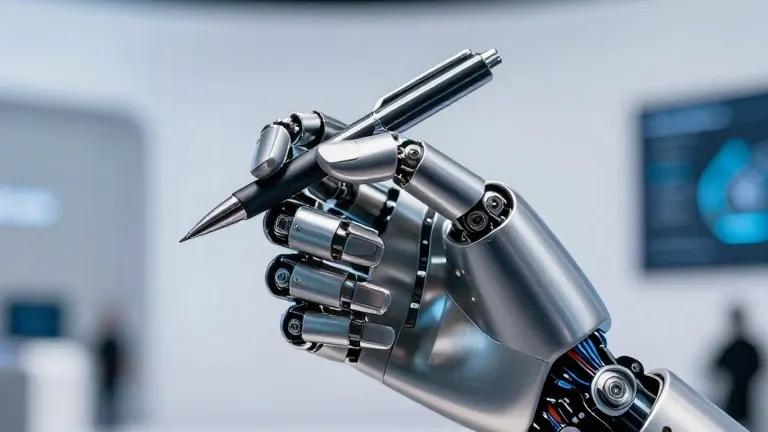
Nvidia has integrated mechanical hands from two Chinese startups into its latest humanoid robot training packages.
The chipmaker displayed two distinct systems in a span of a few months, each relying on different hand technologies. One package featured hands from Sharpa, while the other utilized components from Wuji. Both companies maintain strong ties to founders in Shanghai.
Pan Yunzhe established Wuji in 2019 and subsequently relocated the bulk of the team to Shenzhen. The startup has secured backing from Ant Group, HSG, and Future Capital, according to PitchBook data. A demonstration video released last week showed the Wuji Hand 2 spinning a pen autonomously while facing physical interference.
The Wuji Hand 2 appeared on a presentation slide on Oct. 21. It was positioned behind Nvidia CEO Jensen Huang during a speech in Berlin. Huang introduced a new humanoid hardware system designed to train robots on Nvidia software. The physical body for this system is provided by Agile Robots, a firm with offices in Germany, China, and the U.S.
"It will be the flywheel by which we can accelerate development of robotics," Huang stated regarding the hardware system, designated as the Agile One SN. Agile Robots confirmed the system utilizes Nvidia's Isaac robotics software and the Jetson Thor computing platform.
Nvidia expects research institutions, including Stanford University and ETH Zurich, to begin using the Agile One SN system in early 2027. These same institutions were named in connection with a previous reference humanoid design announced on May 31. That earlier system uses a body from Unitree, a Chinese humanoid company, and hands from Sharpa. It was originally scheduled for delivery in late 2026.
Nvidia did not immediately respond to a request for comment regarding whether deliveries of the first system had started. The company also did not clarify if researchers would test both reference robots or select only one.
Sharpa is headquartered in Singapore and was co-founded by David Li, the CEO of Shanghai-based lidar company Hesai. The company states that its manufacturing research and development takes place in Shanghai. While numerous robotic hand manufacturers exist globally, Sharpa and Wuji have gained prominence in the U.S. tech sector.
Keerthana Gopalakrishnan, a research lead at Google DeepMind, compared the two startups in a podcast last month. She described the Sharpa Wave as slightly stronger than the Wuji hand. She noted that the Wuji hand is closer in size to a typical human hand but possesses the strength of a ten-year-old. It was unclear if she was testing the Wuji Hand 2 or an earlier iteration.
Zhu Mingxuan, a humanoid startup executive, told CNBC in September that Wuji's mechanical hands are lightweight and effective at tasks but prone to heating up. She reported that Sharpa's hands performed better but came at a significantly higher price. Zhu, who previously worked at Figure, identified hardware limitations, particularly hands, as the main challenge in humanoid development.
Xiaomi announced last week that testing its robotic hand in a car factory revealed that most tasks require only a specific range of movement. Meta has also collaborated with Chinese startup Fourier on a humanoid prototype, according to a report by The Information on Oct. 31. Neither company immediately responded to a request for comment on the partnership.
Source: CNBC
More Business · Watch Your Wallet · Report a business · Got a Story?