Mars Cloud Requires Atmospheric Conditions Found Nowhere Else
A new model reproduces the Arsia Mons cloud only by invoking a physical process previously thought impossible in planetary atmospheres.
By Madison Morris ·
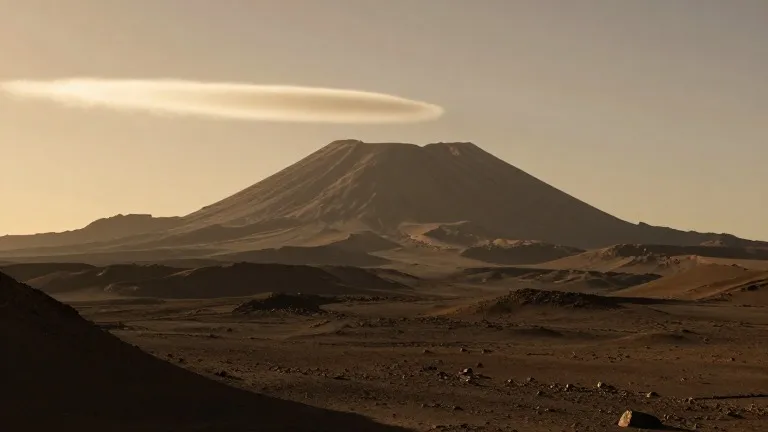
A modeling team at Sorbonne Université in Paris has successfully recreated the daily formation of the Arsia Mons Elongated Cloud, or AMEC. The study, published in Nature Geoscience, identifies a specific mechanism that explains how this 1,000-mile feature forms and vanishes each morning near the Martian volcano.
The AMEC has been a mystery since a probe first detected it in 2018. It appears during Martian spring and summer, growing in length until it spans a distance comparable to the route from New York to Kansas City. The cloud then dissipates, repeating this cycle for months. Previous attempts to model the phenomenon failed because standard cloud physics could not account for its rapid formation and disappearance.
The new simulations work only when they incorporate what lead author Jorge Hernández-Bernal describes as exotic physics. This process, known as homogeneous nucleation, involves water vapor turning directly into ice crystals without the need for dust or salt particles to act as seeds. On Earth, clouds almost always form around tiny debris. Hernández-Bernal compared the Martian process to condensation appearing in the middle of a room rather than on a window.
The conditions required for this type of nucleation are extreme. The model necessitates a temperature drop of 30 degrees Celsius within 10 minutes, alongside very high relative humidity. The Arsia Mons volcano, which stands 65,000 feet high, drives this process. Wind colliding with the mountain generates a wave that lifts moist air rapidly into the upper atmosphere, creating the necessary thermal shock.
The humidity levels required are more than 100,000 times greater than any value measured in Earth's atmosphere. Scientists have long theorized that homogeneous nucleation might occur in the upper atmospheres of Venus and Earth, but it has never been directly observed. The extreme humidity on Mars explains why the process has eluded detection on our own planet until now.
Hernández-Bernal noted that far less is known about the Martian atmosphere than Earth's. The ability to reproduce the cloud with such precision suggests that the atmosphere contains conditions that were previously unrecorded. The study marks the first time a model has accurately simulated the AMEC's lifecycle.
The findings imply that standard assumptions about cloud formation in planetary atmospheres may need revision. While the physics involved appears in textbooks, it is usually treated as theoretical. The successful replication of the AMEC provides the first concrete evidence that this rare process operates in nature.
Source: Wired